
Geo-targeted proxies are proxy servers that route your traffic through an IP address tied to a specific country, region, or city, letting you view a site or app the way a real local user would. For accuracy on tasks like ad verification or local search checks, residential or ISP proxies win. For raw scale where pinpoint geo fidelity matters less, datacenter proxies are cheaper and faster. Mobile proxies exist for one job: carrier-level testing that no other IP type can replicate honestly.
- Residential/ISP — highest trust, best for ad verification and local rendering checks
- Mobile — required for carrier and mobile app testing
- Datacenter — best for large-scale, cost-sensitive scraping where city accuracy is not critical
NullVault provisions credentials in under five seconds across all four types, so you can trial the right one without an approval queue.
Key Takeaways
Geo-targeted proxies work reliably at the country level but require active verification at the city level to avoid silent fallback contaminating your results.
| Point | Details |
|---|---|
| Match proxy type to the job | Residential and ISP for accuracy, datacenter for scale, mobile for carrier-level testing. |
| Country accuracy is strong | Providers commonly report near 99.5% accuracy at country level, dropping to 55 to 80% for cities. |
| Verify, don't assume | Use commands like Proxy.getGeolocation and log ASN and timezone to catch silent fallback. |
| Sample before scaling | Test a small batch against a new city or provider before running a full geo matrix. |
| Start with NullVault | Instant, no-KYC credential provisioning across residential, ISP, mobile, and datacenter pools in 130+ countries. |
Table of Contents
- How Geo-Targeting Actually Routes Your Request
- Which Proxy Type Fits Your Job
- How Accurate Is City-Level Targeting Really?
- Matching the Proxy to the Job
- Setting Up and Verifying a Geo-Targeted Session
- What Geo-Targeted Proxy Plans Actually Cost
- Privacy and Legal Considerations Worth Understanding
- Latency and Performance Trade-Offs You Should Expect
- Security Risks and How to Reduce Them
- NullVault's Geo-Targeting Capabilities in Practice
- NullVault's Take on What Actually Matters in Geo-Targeting
- Get Testable Geo-Targeting Running Today
- Sources
How Geo-Targeting Actually Routes Your Request
Every geo-targeted proxy pulls from a pool of exit IPs mapped to real-world locations. When you request a German IP, the provider isn't creating one on the spot. It's selecting an available address from its German pool, and how deep that pool is determines whether you get Berlin or just "somewhere in Germany." This is why two providers claiming the same country coverage can produce wildly different city-level results.
Configuration usually follows one of three patterns:
- Username flags appended to your proxy credentials, like a
-country-DEsuffix that routes the session without any code change. - API payloads, where you pass a geo_target object with an ISO 3166-1 alpha-2 country code such as
{ country: 'DE' }. - Query parameters on the request itself, common in scraping frameworks that pass geo flags inline.
Whichever pattern you use, pair it with a nocache: true flag whenever the target is price or inventory data. Cached responses from the wrong region will quietly poison your results, and regional pricing pages often differ by currency, tier, or promotion, so a stale cache hides exactly the variation you're trying to measure.
Pro Tip: Run a geo matrix instead of one request at a time. Fire parallel requests with different country codes against the same URL, diff the responses, and you'll catch localization bugs and pricing anomalies in minutes instead of hours.
Which Proxy Type Fits Your Job
Not every job needs the same IP. The trade-off is trust versus cost versus scale, and picking wrong either wastes money or gets you blocked.
- Residential carries the most trust because the IP genuinely belongs to a home internet subscriber, making it the strongest option for bypassing bot detection and getting an accurate local view. Browse residential proxies by country when accuracy is the priority.
- ISP proxies blend that trust with datacenter-grade stability, which makes them a solid fit for account management and social platforms that flag erratic connections. NullVault's ISP proxy lineup covers exactly this niche.
- Datacenter is the cheapest and fastest option, ideal when you're pulling volume and don't need street-level geo precision.
- Mobile is non-optional for carrier-level or in-app ad verification, since only a real carrier IP reproduces what a phone user actually sees.
If your job is bypassing bot checks, choose residential. If it's managing dozens of accounts without tripping flags, choose ISP. If it's scraping thousands of pages fast, choose datacenter. If it's verifying a mobile ad campaign, mobile is the only honest option.
How Accurate Is City-Level Targeting Really?
Country-level targeting is reliable across nearly every provider. City-level targeting is a different story, and the gap between the two is bigger than most buyers expect.
By the numbers: Residential proxy geo-targeting typically hits roughly 99.5% accuracy at the country level, but city-level accuracy can fall to 55–80% depending on the provider and how deep its local IP pool actually is.
That gap exists because of silent fallback. You request a city, the pool doesn't have enough IPs there, and the provider quietly hands you the nearest available address instead of returning an error. Your request "succeeds," but the location is wrong, and nothing in the response tells you that.
Two ways to prevent it:
- Use latitude/longitude with a radius and force strict mode, which rejects any peer outside that radius rather than expanding the search silently.
- Sample before you commit. City-level reliability is market-dependent, so run a handful of test requests against your target city before building a full campaign or scraper on top of it.
Logging the assigned peer's ASN and timezone alongside its city field is the fastest way to catch a fallback after the fact. If the ASN doesn't match the region or the timezone is off by several hours, something went sideways upstream.
Matching the Proxy to the Job
Geo-targeted proxies solve a handful of recurring problems, and each one has a slightly different setup:
- Price monitoring: pair
nocachewith parallel country requests, and lean on residential or ISP proxies for price monitoring since retailers frequently serve different prices to datacenter ranges. - Ad verification: use mobile or residential IPs depending on the campaign, and confirm the creative and redirect chain actually match what the target market's ad verification should show.
- SERP and local SEO checks: country or city-level proxies for rank monitoring, watching for result variance between neighboring cities in the same country.
- App testing: mobile proxies and carrier IPs reproduce the real user experience, including latency patterns that Wi-Fi based proxies can't fake. This is the same job set that providers commonly market geo-targeted proxies for.
Setting Up and Verifying a Geo-Targeted Session
Getting the request right is half the job. Confirming it actually landed where you asked is the other half, and skipping that step is how bad data ends up in a report.
- Request credentials with your target geo baked in, either through a username flag or a
geo_targetpayload. - Send the request with
nocache: trueif you're checking anything time-sensitive or price related. - Verify the assigned peer. Providers that support it expose a verification call, such as Bright Data's Proxy.getGeolocation, which returns the peer's exact geolocation, ASN, and coordinates.
- Log the city, ASN, and timezone for every session so you can spot fallback drift later.
- For multi-region jobs, run the same request across several country codes at once and diff the results, a pattern demonstrated in open geo-scraping examples.
Pro Tip: Build your test checklist once and reuse it: nocache confirmed, IP verified against the target region, headers and redirect chains checked, and a small sample pulled to gauge city-level variability before scaling up.
What Geo-Targeted Proxy Plans Actually Cost
Most providers bill by gigabyte, by time window, or through a prepaid wallet that draws down as you use it. A few offer unlimited pools at a flat rate, usually for datacenter traffic where bandwidth is cheap to provision.
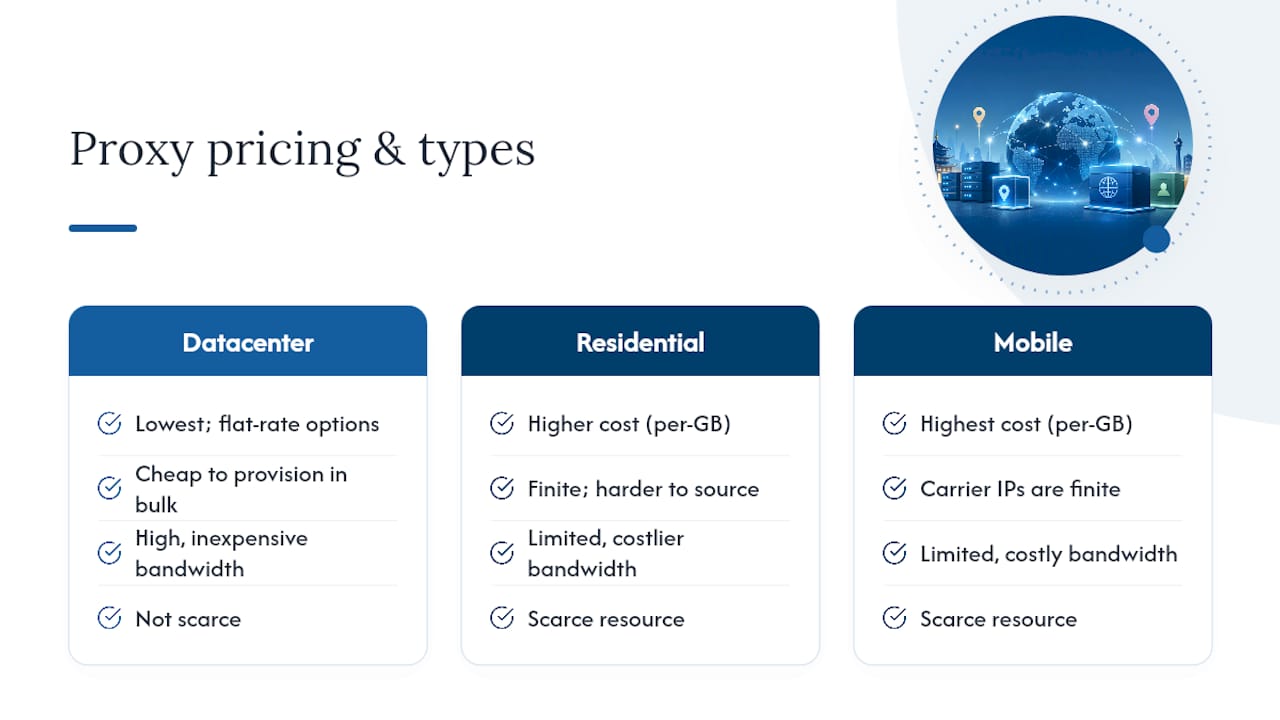
Mobile and residential IPs cost more than datacenter for a simple reason: carrier and home IPs are a finite, harder-to-source resource, while datacenter IPs can be spun up in bulk. If budget is tight, sample a small city matrix before running the full one, throttle request volume on expensive pools, and reserve residential or mobile spend for the checks that actually need that trust level. Also weigh onboarding friction: some providers require identity verification before you can start, while prepaid, no-KYC access gets you testing the same day.
Privacy and Legal Considerations Worth Understanding
Geo-targeted proxies themselves are legal in most jurisdictions, and businesses use them routinely for price monitoring, ad verification, and market research. What determines legal exposure isn't the proxy, it's what you do with it and whose systems you're touching.
Scraping publicly available data through a geo-targeted IP generally sits in a different legal category than bypassing authentication, violating a platform's terms of service, or accessing data behind a paywall. Terms-of-service violations are typically a contract matter between you and the platform rather than a criminal one, but that distinction doesn't make them risk-free. Getting an account banned or an IP range blacklisted is a real, immediate cost even when no law is broken.
Privacy adds a second layer. When your proxy pool routes through residential IPs, that traffic passes through devices belonging to actual people who opted into a network in exchange for compensation or a free service. Reputable providers disclose this relationship to their IP-sharing participants; the ones that don't are worth avoiding regardless of price.
Data protection law is the third factor, and it's the one people underestimate. If your geo-targeted scraping touches personal data, you may fall under regulations like the EU's GDPR or similar regional frameworks, regardless of which country your proxy IP appears to originate from. The proxy changes your apparent location. It does not change which law applies to the data you're collecting or how you're required to handle it.
The practical rule: check the target site's terms of service, avoid scraping anything behind a login wall unless you have explicit permission, and treat personal data with the same caution you'd apply without a proxy in the mix.
Latency and Performance Trade-Offs You Should Expect
Geo-targeted proxies add a hop, and that hop has a cost. How much depends entirely on which IP type you're routing through.

Datacenter proxies are the fastest by a wide margin because the infrastructure sits in high-bandwidth data centers built for throughput, not for mimicking a home connection. Residential and ISP proxies run through consumer-grade networks, which means more variable latency and occasionally lower throughput, especially if the exit device is on a congested home network. Mobile proxies are the slowest of the four in most cases, since carrier networks introduce their own signal variability on top of the proxy hop itself.
Geography compounds this. Routing a request from New York through a proxy exit in Jakarta adds real round-trip distance regardless of proxy type, and that latency shows up in every request, not just the first one. If your workflow involves dozens of regions in parallel, the slowest region in your matrix sets the pace for the whole batch unless you're running requests asynchronously.
Pool depth also affects perceived performance. A thin city-level pool might force you into a slower or more distant peer than a country-level request would, even though both are technically "correct." This is another reason sampling before committing to a full city matrix pays off: you catch performance problems at the same time you catch accuracy problems.
For latency-sensitive jobs like live price checks or SERP monitoring, datacenter or ISP proxies usually deliver the speed you need without sacrificing much accuracy at the country level. Reserve residential and mobile for the specific tests where trust and authenticity outweigh raw speed, and budget extra time in your pipeline when you do.
Security Risks and How to Reduce Them
The biggest security risk with geo-targeted proxies isn't the proxy provider, it's credential handling on your end. Hardcoded proxy credentials in scripts that end up in a shared repository or a public codebase are a common and entirely avoidable leak.
A second risk is the provider itself. Free or unusually cheap geo-targeted proxy pools sometimes source IPs without clear consent from the device owners, which creates both an ethical problem and a reliability one, since those IPs tend to get blacklisted faster. Vet providers on how they source residential and mobile IPs, not just on price.
Man-in-the-middle exposure is a real concern on unencrypted connections. Always route sensitive traffic through HTTPS or, where the provider supports it, SOCKS5 with proper authentication, rather than trusting the proxy tunnel alone to protect your data in transit.
Rotation habits matter too. Using the same sticky session for too long on a sensitive target increases the chance that a single flagged IP takes down your entire operation. Rotating sessions, especially for scraping or account-related work, limits the blast radius when one IP does get burned.
Mitigation comes down to a short list: store credentials in environment variables or a secrets manager, use encrypted connections end to end, choose providers that source IPs transparently, and rotate sessions on a schedule that matches your risk tolerance rather than leaving one session running indefinitely.
NullVault's Geo-Targeting Capabilities in Practice
NullVault provisions proxy credentials in under five seconds, with no identity verification required, across residential, ISP, mobile, and datacenter pools spanning more than 130 countries. For readers coming out of this piece with a specific job in mind, that speed matters: you can go from signup to a live geo-targeted request in the time it takes to read this paragraph twice.
For accuracy-sensitive work, start with the residential proxy pool or the ISP lineup if you need stability alongside trust. For carrier-level app or ad testing, the mobile proxy pages are the right entry point.
During any trial, verify four things before trusting the results: confirm the assigned geolocation against what you requested, measure latency for your specific region, track your success rate across a sample of requests, and, if city targeting matters to your job, run a small sample first to gauge pool depth in that exact city.
NullVault's Take on What Actually Matters in Geo-Targeting
Most guides to geo-targeted proxies treat country and city targeting as the same problem at different zoom levels. They aren't. Country-level targeting is close to a solved problem across the industry, hovering near 99.5% accuracy in independent testing. City-level targeting is closer to a research project you run yourself every time you touch a new market, because pool depth varies by provider, by country, and sometimes by the week depending on churn in the residential network.
The overlooked risk isn't inaccuracy, it's silent inaccuracy. A request that fails loudly gets fixed. A request that returns a plausible but wrong city, with a normal-looking response and no error, sits in your dataset until someone notices the numbers don't add up. That's the actual argument for strict mode and for logging ASN and timezone on every session: not because it's best practice in the abstract, but because it's the only thing standing between you and a report built on the wrong location.
The other habit worth adopting is sampling before scaling. Nobody wants to spend an afternoon test-firing requests before running the "real" job, but skipping that step on a new city or a new provider is exactly how a 200-request matrix turns into 200 requests you have to throw out and redo. Fifteen minutes of sampling is cheaper than a bad dataset every time.
— NullVault
Get Testable Geo-Targeting Running Today
If you've made it this far, you already know the real bottleneck isn't finding a proxy provider, it's finding one that lets you verify accuracy instead of just promising it. NullVault gives you that from the first request: instant credential provisioning under five seconds, no identity checks, and prepaid wallet billing so you're testing within minutes instead of waiting on an approval queue.
Whether your next job is a price-monitoring matrix, an ad verification pass, or a round of app testing from a specific carrier, NullVault's residential, ISP, mobile, and datacenter pools cover the accuracy-to-scale range this article just walked through. Pick the type that matches your job, fund your wallet, and run your first verification request against the residential proxy pages to see your actual assigned geolocation before you commit to a larger campaign.
Sources
- Geotargeting | Tabstack
- Browser API geolocation targeting | Bright Data docs
- Location Proxy | DoubleData
- Geo-targeted scraping examples (GitHub)